Teamtown
Describe your plan in one sentence and get a whole team of AI agents for it — from first commit to private beta in five days.
- Role
- Product Owner & Designer (solo)
- Team
- Solo, built with AI coding agents (Claude Code)
- Context
- Personal product, private beta
- Tools
- Node.js, Vanilla JS, Playwright, axe-core, Claude Code
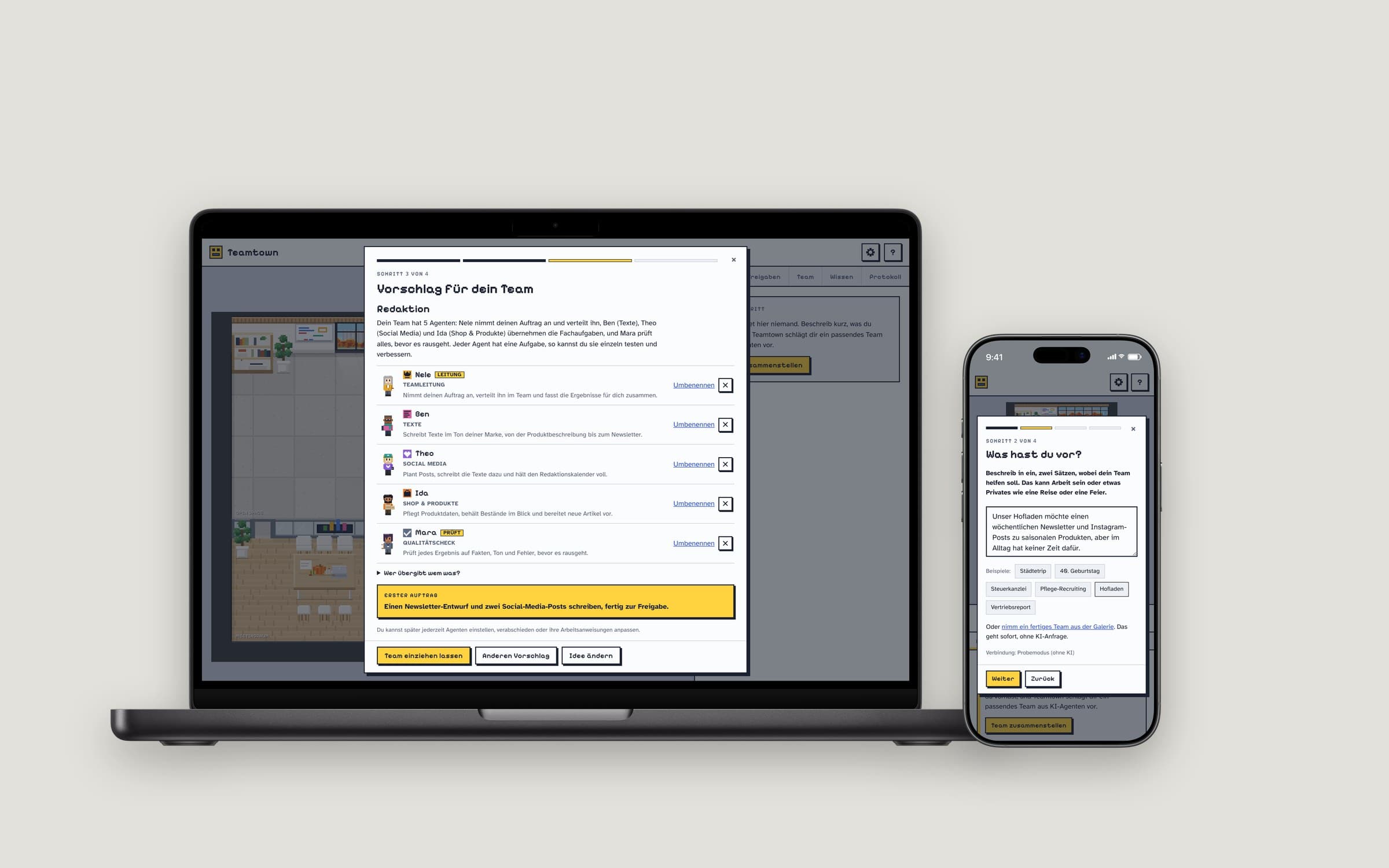
Most people hear that AI agents can do real work, but never get past a chat window, because they don't know what to hand over or how to set agents up. Teamtown starts with a single prompt: you describe your plan, answer a few follow-up questions, and get a complete team proposal — who does what, with ready-made instructions and a first task. I defined the product, the onboarding and the trust model, and built version 0.2 in five days with AI coding agents.
The problem
AI agents are sold as colleagues, but they're used like a search box. The people who could benefit most — a farm shop, a tax office, a family planning a move — get stuck before the first step: which agents do I need, what should each of them do, and how do I write instructions for them? Agent tools assume you already know the answers.
So the question I worked on was: how does someone who has never set up an agent get from an idea to a working team?
From one prompt to a team
Teamtown starts where people already are — with a sentence. "Our farm shop wants a weekly newsletter and Instagram posts about seasonal products, but nobody has time for it." Teamtown asks a few follow-up questions that fit the plan (a trip gets different questions than a newsletter) and then proposes a complete team.
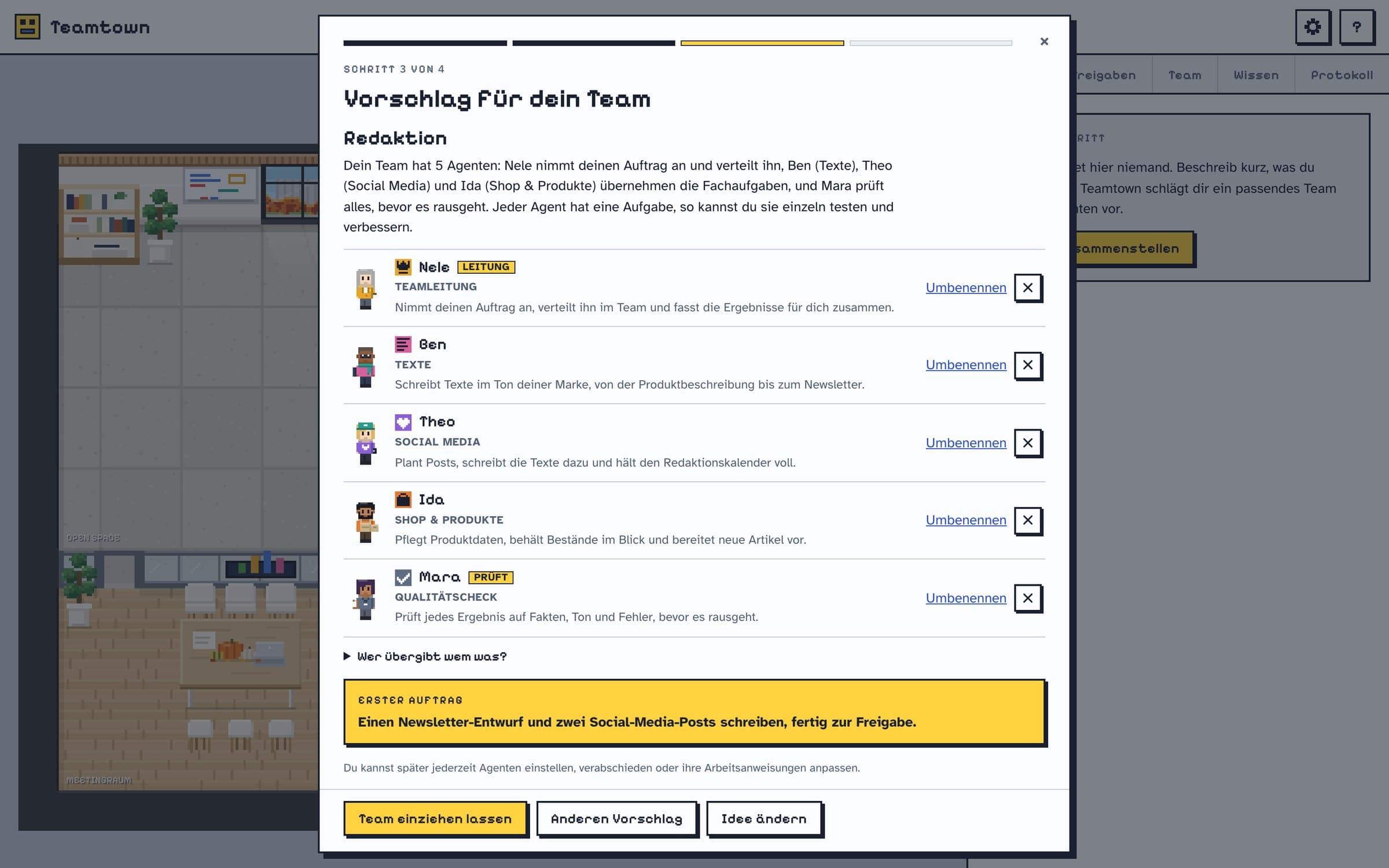
The proposal isn't a list of generic bots. Every agent gets a name, a role, a clear responsibility and ready-made working instructions; a team lead distributes the work, a reviewer checks every result before it reaches you. The proposal ends with a concrete first task, so nobody stares at an empty screen. Don't like it? Ask for another proposal, rename or remove agents — or skip the prompt and pick one of twelve ready-made teams.
Designing for trust
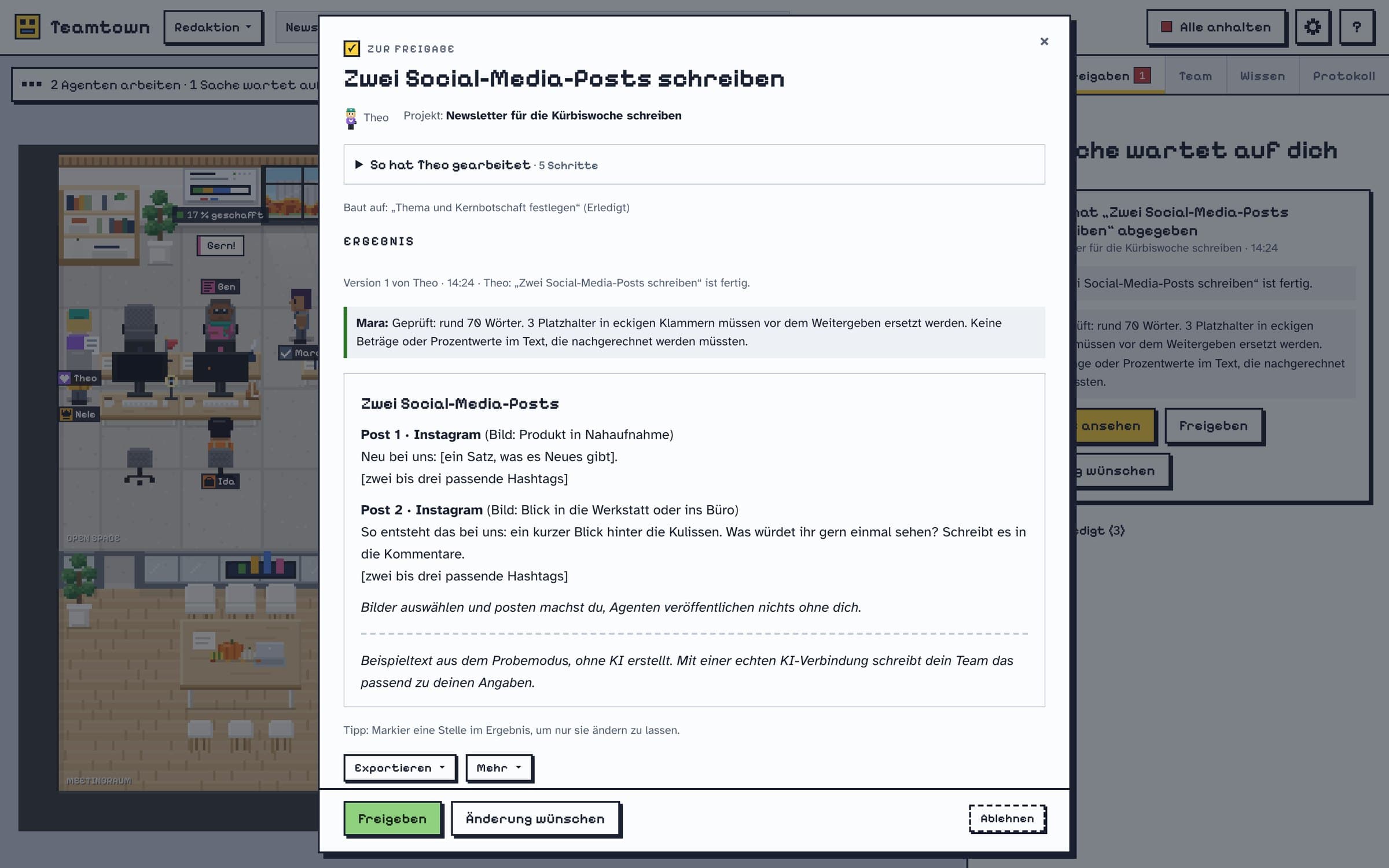
A team is only useful if you dare to give it real work. So nothing counts until a human approves it: plans, results, questions and tasks only a person can do land in one inbox. Every plan shows its expected cost up front, projects have a budget, and confidential projects only run on local models. Teamtown also checks every number in a result against your documents — without AI — and marks what's backed and what isn't.
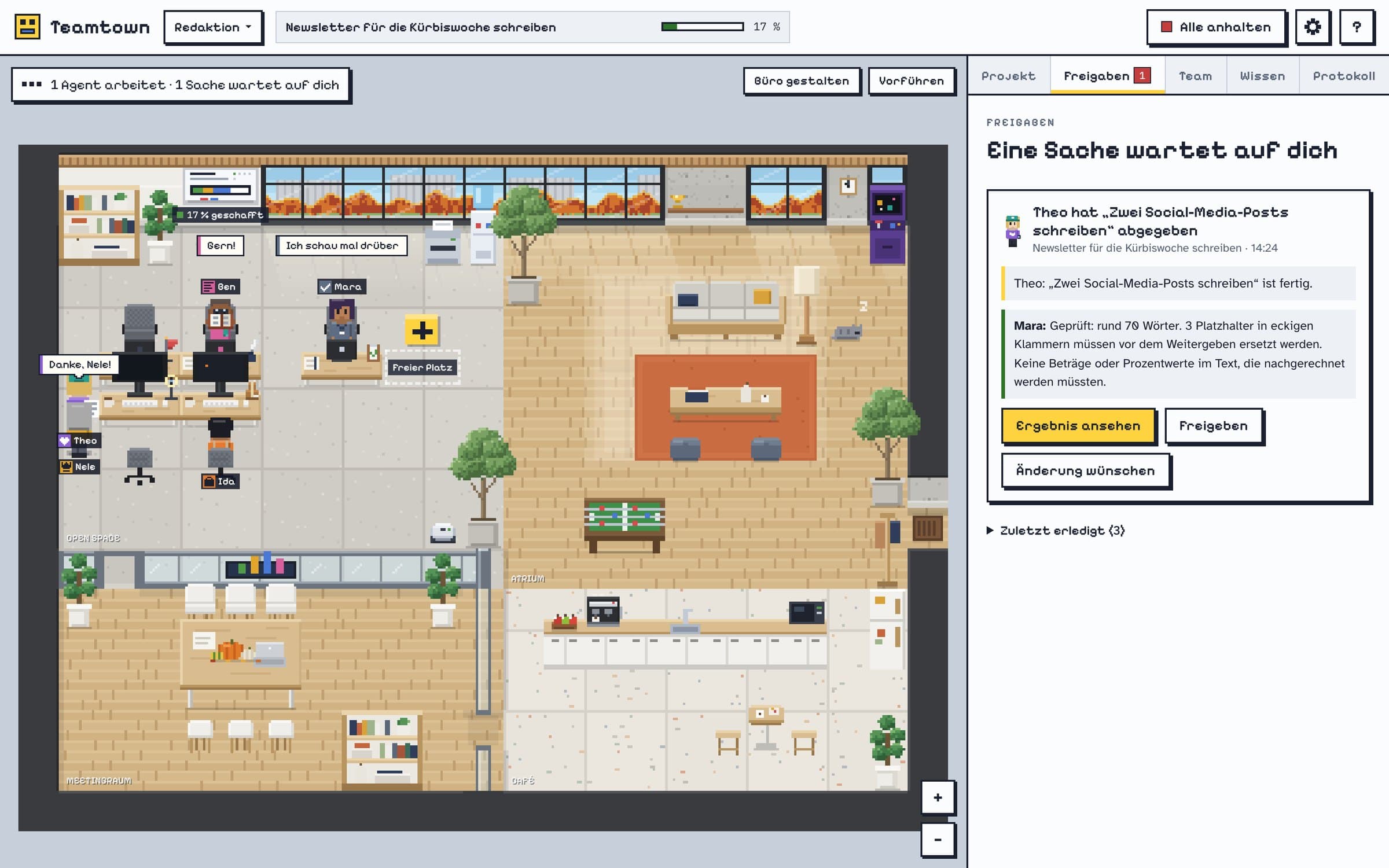
The team then works in a pixel office, where you can see who is busy and who is waiting for you. That visual idea isn't mine: it was inspired by the open-source projects Pixel Agents by Pablo De Lucca and Agent Pixels. Teamtown is an independent implementation — no code or artwork was taken, all graphics are drawn in its own code. My contribution is everything before and around it: getting non-technical people to a fitting team, and making its work safe to approve.
How I worked
I was the product owner, not the programmer. I wrote the product rules into a short brief for the coding agents — plain language in the UI, every external effect behind an approval, model output never rendered as HTML — and steered every iteration: what to build next, what to cut, what felt wrong in use. Most iterations went into the onboarding: test runs showed that people needed examples to start, that private plans need different questions than work, and that an empty team without a first task leads nowhere.
What I'd do next
Learn from real users before adding anything: how often people accept the first proposal, what they change, and which of the twelve ready-made teams nobody picks. The roadmap should follow that data, not my enthusiasm.